sat suite question viewer
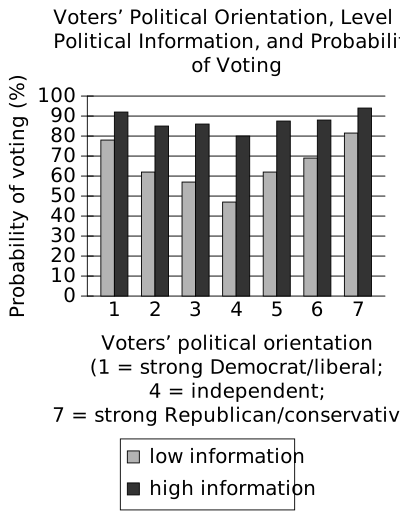
- For each data category, the following bars are shown:
- low information
- high information
- The data for the 7 categories are as follows:
- 1:
- low information: 78%
- high information: 92%
- 2:
- low information: 62%
- high information: 85%
- 3:
- low information: 57%
- high information: 86%
- 4:
- low information: 47%
- high information: 80%
- 5:
- low information: 62%
- high information: 87.5%
- 6:
- low information: 69%
- high information: 88%
- 7:
- low information: 81.5%
- high information: 94%
- 1:
Economists Kerwin Kofi Charles and Melvin Stephens Jr. investigated a variety of factors that influence voter turnout in the United States. Using survey data that revealed whether respondents voted in national elections and how knowledgeable respondents are about politics, Charles and Stephens claim that the likelihood of voting is driven in part by potential voters’ confidence in their assessments of candidates—essentially, the more informed voters are about politics, the more confident they are at evaluating whether candidates share their views, and thus the more likely they are to vote.
Which choice best describes data in the graph that support Charles and Stephens’s claim?
Explanation
Choice A is the best answer because it uses data from the graph to effectively support Charles and Stephens’s claim about how level of information affects voters. The graph shows the probability of voting for both high- and low-information voters in seven categories of political orientation. Charles and Stephens claim that “the more informed voters are about politics…the more likely they are to vote.” This statement correctly asserts that the graph shows a higher probability of voting for high-information voters than for low-information voters at each of the seven political orientations. Thus, this statement accurately cites data from the graph that support Charles and Stephens’s claim about how level of information affects voters.
Choice B is incorrect. Although this statement is correct that the only probability in the graph below 50% is for low-information voters categorized as independent (orientation 4), the claim in question is about the relative likelihood that low- and high-information voters will vote, and without some reference to high-information voters, this statement cannot help support such a comparison. Choice C is incorrect. Although this statement is correct that the highest probabilities of voting for low-information voters are at the ends of the orientation scale (1 and 7), the claim in question is about the relative likelihood that low- and high-information voters will vote, and without some reference to high-information voters, this statement cannot help support such a comparison. Choice D is incorrect because the graph does not give any information about how many people are represented in any of the categories, so this statement is not based on data from the graph. Furthermore, even if we did have this information, the claim is about how level of information affects voters’ probability of voting, not whether they’re likely to strongly identify with a particular political party.